
AI
Is Now Reading Your Echocardiogram

You walk into the echo lab. The tech wipes your chest with cold gel. You hold your breath. The probe glides over your skin, sending sound waves into your chest like sonar in the deep ocean. Your heart pulses in real time on the screen: chambers squeezing, valves snapping shut, blood surging forward. This is an echocardiogram – a heart ultrasound, the most common heart imaging test worldwide.
Until recently, reading that movie took time. Your doctor sat there squinting at the screen, dragging lines over chamber walls, tracing edges, calculating numbers by hand. Twenty minutes. Maybe more. Two experts could read the same scan and disagree by five to ten percent – like two people measuring the same room with different tape measures.
Now that is changing fast.
Four Tools Already in Your Hospital
Four FDA-cleared AI tools are currently live in hospitals. They are built into the echo machines themselves – not in labs, not in pilot programs.
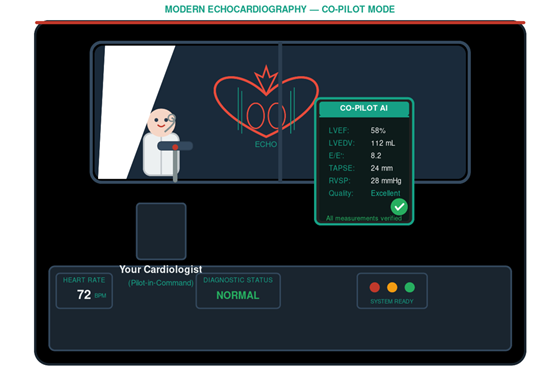
AI co-pilot – your cardiologist plus AI in the cockpit
Us2.ai delivers a full echo report in seconds. Every chamber measured, every valve checked, every number your doctor needs. Upload the study and the report appears – no extra clicks. It is already in use at major US and European centers.
InVision made history in Nature in 2020 with the first randomized trial of AI in cardiology. AI helped human readers catch disease they would otherwise miss, especially when they were tired or rushed. Starting in January 2025, Medicare will cover AI-assisted echo reads for heart failure (billing code CPT 0932T). That is infrastructure, not a trial.
Ultromics EchoGo won FDA approval in late 2024 for cardiac amyloidosis – a condition in which misfolded proteins stiffen the heart, like rust in a pump. It is often missed for years. EchoGo spots it from a single echo view: it catches 85 percent of cases and rarely flags a healthy heart. Like a smoke alarm for a dangerous fire you cannot see.
iCardio.ai auto-detects aortic stenosis – a narrowed heart valve that forces your heart to work harder, like drinking a milkshake through a bent straw.
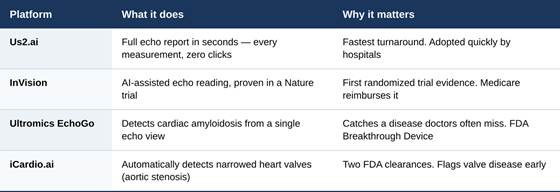
AI echo platforms compared – four FDA-cleared tools already in use
Your Doctor Now Has a Co-Pilot
Think of an airplane cockpit. The pilot is your doctor – the one who knows your story, the chest pain last Tuesday, your mother’s history, how you still walk your dog but need two pillows to sleep. The co-pilot is the AI. It watches the instruments, calls out every number, and flags anything odd. The co-pilot does not land the plane. It makes sure the pilot sees everything.
Instead of spending twenty minutes on manual tracing, your doctor gets a full report in seconds. That time is now spent on you – deciding what the numbers mean for your life, not just what they say on a screen.
An ejection fraction of 40 percent tells the AI one thing. Your doctor knows you still coach soccer on weekends. That context changes everything.
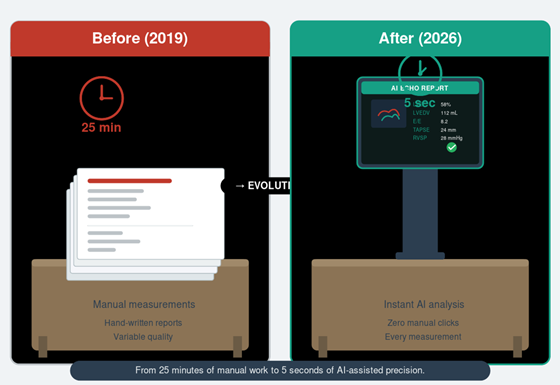
Echo reading before and after AI – from 20 minutes to seconds
What the AI Does Not Replace
The AI cannot sit in the room with you. It does not ask about your work stress or whether you skipped your meds last week. It does not know you get winded carrying groceries. Those things matter as much as any number – maybe more.
The AI is a sharper lens on a test you were already getting. It is not a new test. It is a faster, more consistent read of the same test. The pilot still flies the plane.
What to Do at Your Next Visit
· Ask: “When you read my echo, do you use AI?” Most clinics do not volunteer it.
· Ask: “Will the AI report show up on my results?” It often does.
· If the AI flags something, do not panic. A flag is a starting point. Your doctor takes it from there.
The best part of your visit is not the machine reading the images. It is the person reading you.
Your heart does not care about the latest headline. It cares about what you do today.
Robert E. Henson II, MD FACC
Disclaimer
All information provided by Cardiology 123!™ and Dr. Robert E. Henson II, MD FACC – including messages, images, advice, URLs, and any other material – is for informational purposes only and is not a substitute for professional medical advice, diagnosis, or treatment. If you are experiencing a medical emergency, call 911 or your local emergency services immediately. Always seek the advice of your physician or other qualified health providers with any questions you may have regarding your health. Never disregard professional medical advice or delay seeking it because of something you have read here or elsewhere on the internet. While we strive for accuracy, medical knowledge advances rapidly, and information may become outdated. In the final analysis, nothing supersedes expert, personalized care.